
What Most Nigerians Still Don’t Understand About Fast Charging Technology
23/06/2026 | Poolee Store
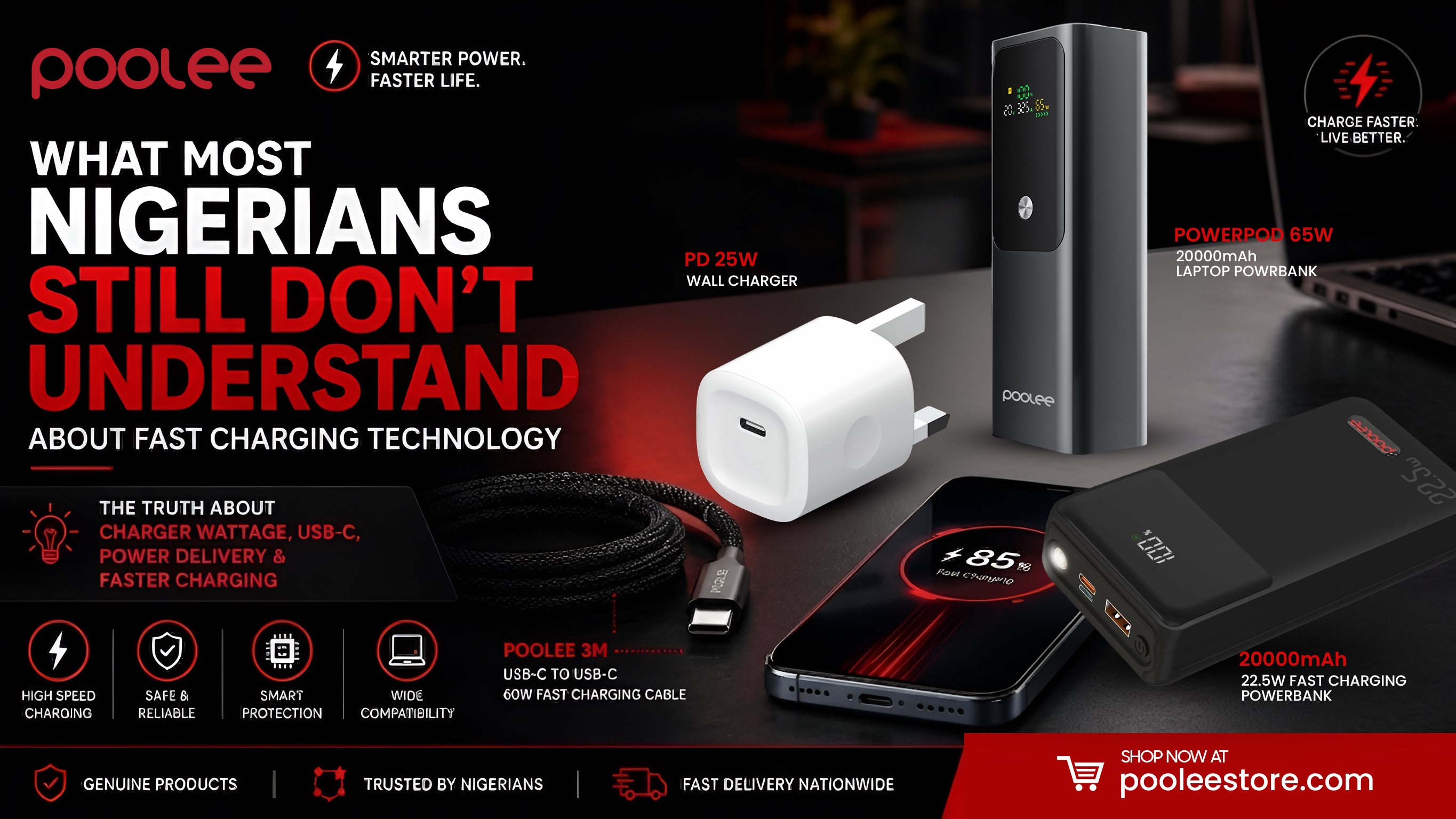
What Most Nigerians Still Don’t Understand About Fast Charging Technology
Imagine this.
NEPA takes light unexpectedly. Your phone is down to 8%, and you have an online meeting in 30 minutes.
You quickly plug your phone into a new "65W fast charger" expecting your battery percentage to shoot up.
But an hour later, your phone is still charging slower than expected.
So what happened?
The truth is that most Nigerians misunderstand how fast charging technology actually works.
Many people assume that buying a charger with a higher wattage automatically guarantees faster charging. Unfortunately, that's not how modern charging technology works.
Your charging speed depends on several factors working together:
Your charger
Your smartphone
Your charging cable
Your charging protocol
Your battery condition
Your phone's temperature
Understanding these factors can help you charge faster, protect your battery, and avoid wasting money on accessories that don't deliver the performance you expect.
What Fast Charging Actually Means
The Simple Definition Most People Miss
Quick Answer: What Is Fast Charging?
Fast charging is a technology that allows a smartphone, tablet, or other device to receive more power safely than standard charging, reducing charging time significantly.
Many people think fast charging simply means "more electricity."
In reality, fast charging is a carefully controlled process where your charger and device communicate to determine how much power can be delivered safely without damaging the battery.
Modern smartphones continuously adjust charging speed to balance performance, heat management, and battery health.
Why Charging Speed Is Measured in Watts
When discussing charging speeds, you'll often hear terms like:
20W charger
25W charger
33W charger
45W charger
65W charger
The "W" stands for Watts.
The formula is simple:
Watts = Volts × Amps
For example:
5V × 2A = 10W
9V × 3A = 27W
20V × 3.25A = 65W
Think of it like water flowing through a pipe.
Voltage is the pressure.
Current (amps) is the volume of water flowing.
Watts represent the total amount of power delivered.
The higher the wattage your phone supports, the faster it can potentially charge.
Why a Bigger Number Doesn't Always Mean Faster Charging
This is where many Nigerians get confused.
A 65W charger is not automatically faster than a 20W charger for every device.
Consider this example:
Phone A supports only 20W charging.
Phone B supports 33W charging.
Phone C supports 65W charging.
If all three phones are connected to the same 65W charger:
Phone A will still charge at 20W
Phone B will still charge at 33W
Phone C can charge at 65W
The charger cannot force your phone to accept more power than it was designed to handle.
This is one of the biggest reasons people buy powerful chargers and still experience disappointing charging speeds.
Why Your Phone Decides the Charging Speed—Not Just the Charger
The Biggest Fast Charging Myth in Nigeria
One of the most common statements you'll hear is:
"My charger is 65W, so my phone charges at 65W."
Not necessarily.
Your phone determines how much power it accepts.
A charger only offers power.
The phone decides how much of that power it will use.
This is why two people can use the same charger and get completely different charging speeds.
Every Smartphone Has a Charging Limit
Different devices support different charging speeds.
Examples include:
Entry-Level Android Phones
Many budget smartphones support between 10W and 18W charging.
Mid-Range Smartphones
Many support between 18W and 33W charging.
Premium Flagship Devices
These often support 45W, 65W, or even higher charging speeds.
iPhones
Modern iPhones support fast charging but have their own charging limitations and optimization systems.
No matter how powerful your charger is, your device will never exceed its maximum supported charging speed.
Why Some Phones Charge Faster Than Others Even With the Same Charger
Two phones connected to the same charger can charge at different speeds because of:
Different battery sizes
Different charging protocols
Different battery management systems
Different thermal controls
This is why comparing charging speeds between brands isn't always straightforward.
The Fast Charging Standards Most Nigerians Have Never Heard Of
Many people focus only on wattage.
The real secret often lies in charging standards.
USB Power Delivery (USB-PD)
USB Power Delivery (USB-PD) has become one of the most widely supported charging standards in the world. It allows devices and chargers to communicate and negotiate the safest and fastest charging speed available.
USB-PD is now commonly used for:
Smartphones
Tablets
Laptops
Power banks
Wireless earbuds
This universal compatibility is one reason USB-C and USB-PD are becoming industry standards.
Qualcomm Quick Charge (QC)
Quick Charge is a fast charging technology developed by Qualcomm.
It is widely supported across many Android smartphones and works by increasing voltage and optimizing power delivery to reduce charging times.
Many Android users unknowingly use Quick Charge every day.
PPS Charging Technology
PPS stands for Programmable Power Supply.
It is an advanced extension of USB-PD that allows more precise adjustments to voltage and current during charging. This helps improve efficiency, reduce heat, and optimize charging performance.
Many modern Samsung, Google Pixel, and flagship Android devices benefit from PPS-compatible chargers.
Proprietary Charging Systems
Many manufacturers also use their own fast charging technologies.
Examples include:
Samsung Super Fast Charging
Xiaomi HyperCharge
OPPO SuperVOOC
OnePlus Fast Charging
These systems often deliver exceptional speeds but may require specific chargers and cables to achieve maximum performance.
Why Compatibility Matters More Than Wattage
Quick Answer: What's the Difference Between USB-PD and Quick Charge?
USB-PD is a universal fast charging standard used across smartphones, tablets, power banks, and laptops, while Qualcomm Quick Charge is primarily designed for compatible Android devices. USB-PD focuses on universal compatibility, while Quick Charge is optimized for Qualcomm-powered devices.
This is why a 65W charger may not deliver full speed if it doesn't support your phone's preferred charging protocol.
Compatibility often matters more than wattage.
Why Your Charging Cable Could Be Slowing Everything Down
Many Nigerians spend money on premium chargers while using low-quality cables.
That is like buying a powerful water pump and connecting it with a tiny pipe.
Cheap Cables vs Quality Cables
A poor-quality cable can dramatically reduce charging speed.
Cheap cables commonly sold in markets may:
Limit power delivery

Sign Up For Newsletters
Poolee is a dynamic and innovative brand that specializes in providing a wide range of electronic accessories to meet the modern lifestyle needs of tech-savvy consumers.